
The Homeowners Guide to Safely Powering Inflatable Yard Decorations
Inflatable yard decorations have become one of the easiest ways to dress up a front lawn for fall and the holiday season ahead. They go up in minutes, they store flat, and they pull attention from every car that passes the house. The part most homeowners overlook is the electrical side of the display, because every inflatable runs on a small blower motor that has to stay powered for hours at a time. That blower needs a properly protected outdoor receptacle, a cord rated for wet conditions, and a circuit with enough room left over to carry the load. When any one of those pieces is missing, the result is usually a tripped breaker, a nuisance trip in the middle of the night, or a damaged cord that becomes a shock hazard on wet grass. This guide walks through how to power inflatable yard decorations correctly at a home in Lone Oak or anywhere across Hunt County and Rains County. Everything below follows the same code requirements a licensed electrician applies when wiring any outdoor circuit.
What It Takes to Power Inflatable Yard Decorations Safely
Powering inflatable yard decorations safely comes down to three things working together: the receptacle, the cord, and the circuit behind them. Each inflatable ships with a short cord and a blower motor that runs continuously from the moment the display switches on until it shuts off for the night. That motor is a small load on its own, but a yard full of inflatables adds up quickly once four or five of them share the same outlet. Outdoor receptacles also live in what the National Electrical Code calls a wet location, which holds them to stricter standards than anything installed inside the house. Homeowners who understand those standards can run a large display all season without a single nuisance trip. The sections below break down each requirement in the order you should think about it.
The Outdoor Outlet Requirements for Powering Inflatable Yard Decorations
Every outdoor receptacle that powers an inflatable has to have ground fault circuit interrupter protection, and that requirement is not optional under current code. Section 210.8 of the National Electrical Code requires GFCI protection for all 125 volt, 15 and 20 amp receptacles installed outdoors at a dwelling. A GFCI device compares the current leaving on the hot conductor with the current returning on the neutral, and it opens the circuit when it sees an imbalance of roughly four to six milliamps. That imbalance is the signature of current leaking somewhere it was never meant to go, which on a wet lawn very often means through a person. Six milliamps sits well below the level that causes the muscle contraction that prevents someone from letting go of an energized cord. Older homes around Lone Oak, Point, and Emory sometimes still have exterior receptacles installed before the requirement was expanded, and those outlets look identical to a protected one from the outside. The only way to know for certain is to test the device or trace the circuit back to a GFCI breaker in the panel.
The receptacle itself also needs to be listed as weather resistant, which is marked with the letters WR on the face of the device. Weather resistant receptacles use materials and plating that hold up to ultraviolet light, temperature swings, and the humidity that rolls in off Lake Tawakoni through the fall and winter. On top of that, any outdoor receptacle in a wet location needs a cover that keeps the opening protected while a cord is plugged in. These are commonly called in use covers or bubble covers, and they replaced the older flip lid covers that only sealed when nothing was plugged in at all. The distinction matters a great deal for a seasonal display, because an inflatable cord stays plugged in for weeks through rain, dew, and irrigation overspray. A flip lid cover propped open by a cord end offers no real protection once water starts running down the face of the wall. Replacing that cover is inexpensive, and it is one of the fastest upgrades an electrician can make to an existing outdoor outlet.
The number of outdoor receptacles matters as much as their condition. Code requires at least one receptacle at the front and one at the back of a dwelling, but two outlets rarely serve a full yard display spread across a large lot. Homeowners fill that gap by running long cords from the garage or by cracking a window to reach an interior outlet, and both habits create real problems. A cord pinched in a door or window jamb takes damage to the insulation every time the door moves, and that damage stays invisible until the cord faults. Adding a properly placed exterior receptacle near the display area removes the need for the long run entirely and eliminates the trip hazard that comes with it. Need a protected outlet for your display? Click here for our GFCI outlet installation service. An electrician can place the new outlet on a circuit with capacity to spare and tie it to a switch or timer inside the house.
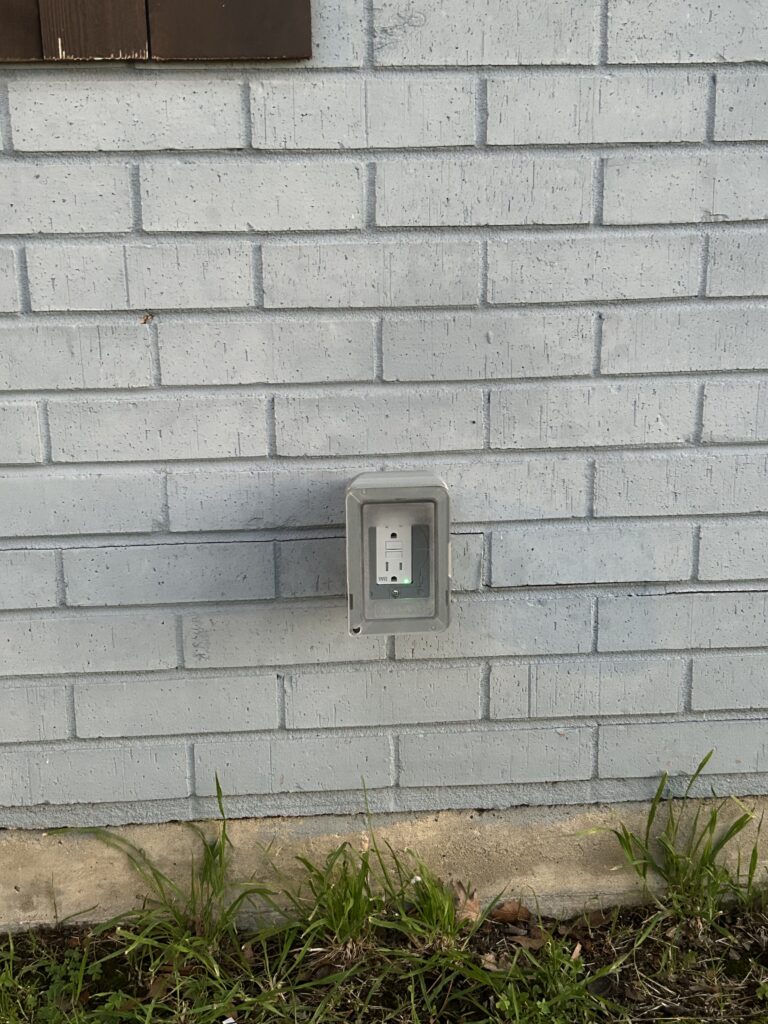
Extension Cord Rules for Powering Inflatable Yard Decorations
Extension cords used outdoors have to be rated for outdoor use, and the marking printed on the jacket tells you exactly what you have. Look for a W in the type designation, such as SJTW or SJEOW, because that letter identifies a cord approved for wet conditions. Indoor cords with thin brown or white jackets are built for lamps and vacuum cleaners, and the insulation on them breaks down quickly under sunlight and standing water. Conductor size is the second half of the equation, and cords are labeled by American Wire Gauge, where a smaller number means a larger conductor. A 16 gauge cord handles light loads out to roughly 25 feet, a 14 gauge cord is the better choice out to 50 feet, and runs approaching 100 feet should use 12 gauge. Undersized cords heat up and drop voltage along their length, which forces a blower motor to work harder and run hotter than the manufacturer intended. Buying one heavy cord of the correct length costs far less than replacing a burned out blower halfway through the season.
Connecting several cords end to end is one of the most common mistakes in a yard display, and it causes more trouble than most homeowners expect. Every connection point adds resistance and creates another opening where moisture can work its way into the contacts. Voltage drop compounds across a chained run, so the inflatable at the far end of the yard receives noticeably less voltage than the one sitting closest to the house. Manufacturers list a maximum length on the cord packaging for good reason, and stacking cords together blows past that rating immediately. Indoor power strips and surge protectors have no place in a yard display either, since their enclosures are not sealed against water and their internal components corrode quickly. Outdoor rated multi outlet blocks with covered receptacles exist for exactly this purpose and cost very little. One cord of the correct length running to a covered outdoor splitter is the cleanest approach for a cluster of inflatables.
How the cord runs across the yard matters just as much as what the cord is made of. Keep every connection point off the ground, since a coupling lying in wet grass gives water a direct path into the contacts. A simple drip loop, meaning a downward bend in the cord just before it reaches the outlet, lets water run off instead of following the cord into the receptacle. Cords should never be run under rugs, doormats, or mulch, because trapped heat has nowhere to escape and foot traffic slowly grinds through the jacket. Where a cord crosses a walkway, use a molded cord ramp rather than tape or staples that pierce the insulation and create a fault waiting to happen. Stakes and tethers deserve attention as well, since driving a spike through a shallow low voltage lighting cable or an irrigation wire is easy to do and difficult to find later. Homeowners planning to drive anything deeper than a few inches should call 811 before they start, especially near the meter, the service lateral, or a septic field.
Circuit Load Limits When Powering Inflatable Yard Decorations
Sizing the circuit starts with knowing what an inflatable actually draws. Most residential inflatables use a small blower rated somewhere between 40 and 150 watts, which works out to roughly a third of an amp up to about one and a quarter amps at 120 volts. Larger commercial style inflatables and the tall arch pieces can pull two amps or more, and many models add internal LED lighting on top of the blower load. Those numbers look harmless in isolation, which is precisely why displays keep growing until something finally trips. The nameplate on the blower housing or the specification sheet in the box lists the wattage, and writing those figures down before setup takes only a few minutes. Add the total for every inflatable, string light set, projector, and timer that will share the same circuit. That single number tells you exactly what you are asking the circuit to carry every night.
A standard 15 amp residential branch circuit can carry 1,800 watts at 120 volts on paper, and a 20 amp circuit can carry 2,400 watts. Those figures are ceilings rather than targets, because the code limits a continuous load to 80 percent of the breaker rating. A load that runs for three hours or more counts as continuous, and a holiday display running from dusk until midnight qualifies without any question. That brings the practical limit to about 1,440 watts on a 15 amp circuit and about 1,920 watts on a 20 amp circuit. Exterior receptacles are frequently shared with garage outlets, so a chest freezer, a well pump controller, or a battery charger may already be sitting on that same circuit. Loading a circuit to its edge leaves nothing in reserve for the inrush a blower motor draws at startup. Staying under the 80 percent figure keeps the display stable and keeps the breaker from cycling on cold nights when motors work harder than usual.
Some homes simply do not have the outdoor circuit capacity a large display needs. That shows up most often in houses built before outdoor entertaining and holiday lighting became standard expectations, where the entire exterior may run from one shared circuit. The fix is never a larger breaker on the existing wire, since the breaker protects the conductor and installing a bigger one strips away that protection completely. The correct answer is a new dedicated circuit run from the panel, or a subpanel when the main panel has no open spaces left to work with. Panels that are full, obsolete, or showing signs of heat damage need attention before any new load is added to them. An electrician can perform a load calculation on the existing service and tell you precisely how much room remains before anything is connected.
Common Electrical Problems With Inflatable Yard Decorations
Most electrical problems with inflatable yard decorations show up the same handful of ways every single season. A GFCI trips at two in the morning and the entire display sits flat on the lawn by sunrise. A breaker trips the instant a timer switches everything on at once, or a blower runs weakly and makes a grinding sound after a heavy rain. Each of those symptoms points back to a specific cause, and none of them should be written off as a quirk of the decorations themselves. Reading the symptom correctly saves hours of unplugging and replugging cords in the dark with a flashlight. The following sections cover the three problems homeowners report most often and explain what actually fixes them.
Tripped GFCI Outlets Caused by Inflatable Yard Decorations
A GFCI outlet that keeps tripping is doing exactly what it was designed to do, and the first instinct to replace it with a standard receptacle is the wrong move. The device monitors the difference between outgoing and returning current and opens in a fraction of a second when it detects leakage to ground. Moisture inside a cord end is the leading cause of that leakage in an outdoor display, because water bridges the gap between the energized blade and the grounded parts surrounding it. Heavy dew alone is often enough, which explains why displays fail overnight and appear perfectly fine at noon after the sun has dried everything out. Sprinkler heads that spray across a cord coupling produce the same result on an automatic irrigation schedule. Leakage is also cumulative across a circuit, so five inflatables each leaking one milliamp will trip a device that tolerates none of them individually. That cumulative effect is why a display works fine with three inflatables and fails the day a fourth one joins it.
Damaged equipment produces trips that no amount of drying will ever fix. Blower motors pull air across their windings continuously, and dust, pollen, and grass clippings collect inside the housing over several seasons of use. Contamination on the windings creates a leakage path, and the motor may still run normally while sending enough current to ground to trip a GFCI. Cracked cord jackets do the same thing, particularly at the point where the cord leaves the molded plug and flexes every time wind moves the inflatable. Storage damage is a frequent culprit, since cords crushed under bins in a hot attic all summer come out with brittle, cracking insulation. Rodent damage during storage is worth checking as well, because a chewed jacket may show only a small opening that is easy to miss. Any cord with exposed conductors, a cut, or a previous repair made with electrical tape belongs in the trash rather than back out in the yard.
Isolating the cause takes a systematic approach rather than guesswork in the dark. Unplug everything from the circuit, reset the GFCI, and confirm the device holds with no load connected to it at all. Add one inflatable at a time, waiting a few minutes between each addition, and note which one causes the trip. The offending item is either the last one connected or the combination that now exceeds the tolerance of the device. A GFCI that will not reset with nothing plugged in points toward a problem in the wiring or a failed device, and both situations call for a licensed electrician. GFCI devices wear out over time, and ten to fifteen years is a reasonable service life for one exposed to outdoor conditions year round. Testing every GFCI in the house monthly with the built in test button is a habit worth keeping in every season.

Water and Moisture Damage Around Inflatable Yard Decorations
Water finds its way into a yard display through paths most homeowners never stop to consider. The obvious one is rain, and East Texas storms deliver plenty of it through the fall and into the winter months. Less obvious is the water that collects in the fabric folds of a deflated inflatable and then drains straight down onto the blower housing and cord connection at the base. Yards that hold water after a storm turn ordinary cord connections into submerged connections, and no outdoor cord is designed to sit underwater for hours. Irrigation systems running on an automatic schedule soak the same spot night after night without anyone noticing the pattern. Morning dew coats every surface in the yard and works into any connection that is not both elevated and covered. Each of these paths deserves attention during setup rather than after the first failure.
Elevating connections is the single most effective habit in a humid climate like ours. Hanging a coupling on a stake, a shepherd hook, or a hook screwed into a post keeps it out of standing water and lets air circulate freely around it. Inexpensive cord connection covers seal a coupling inside a plastic shell and cost only a few dollars each. Positioning inflatables on the highest available ground rather than in a low spot prevents the blower from sitting in a puddle after a heavy storm. Mulch beds trap moisture against a cord and hold it there long after the surface has dried, so route cords along the edge of a bed instead of straight through it. The receptacle end deserves the same care, with the in use cover fully closed around the cord and the gasket seated flat against the wall. Small habits like these prevent the large majority of moisture related failures in a seasonal display.
Moisture damage carries into the next season when equipment goes into storage while it is still wet. Corrosion works on blower motor contacts and cord blades slowly, and the damage often does not reveal itself until the unit is plugged in a full year later. Inflatables should be completely dry before they go into a bin, which usually means running the blower for an hour on a dry day and then laying the fabric out flat. Cords need to be coiled loosely rather than wrapped tightly around a hand, since tight wrapping stresses the conductors inside the jacket and eventually breaks strands. Storing the display in a conditioned space rather than an attic protects the insulation from the heat cycling that makes it brittle and prone to cracking. Inspect every plug for green or white residue on the blades before the display goes back up, because that residue is a clear sign of corrosion. Replacing a questionable cord costs far less than the repair that follows a fault in a wet yard.
Overloaded Circuits and Breaker Trips From Inflatable Yard Decorations
A breaker trip and a GFCI trip look identical from the yard but mean very different things inside the wiring. A GFCI trip signals current leaking to ground, and the reset button sits on the device itself or on a GFCI breaker in the panel. A standard breaker trip signals too much current flowing through the conductor, and the handle in the panel will rest between the on and off positions. Knowing which device opened tells you where to look, and that difference alone saves a great deal of wasted effort. Overload trips almost always happen at the exact moment a timer energizes the whole display at once. Blower motors draw a brief inrush current at startup that is several times their running current, and starting eight of them simultaneously creates a spike that a loaded circuit cannot absorb. Staggering timers by a few minutes across separate groups often resolves the problem without any wiring changes at all.
Adding up the loads already on the circuit usually explains the trip completely. Exterior receptacles in many homes share a circuit with the garage, which may already carry a chest freezer, a garage door opener, a battery charger, or a well pump control. A freezer compressor cycling on while the display is running can push a marginal circuit past its limit at a completely random hour of the night. Circuits that also feed a bathroom receptacle become a problem the moment someone uses a hair dryer in the morning. Mapping the circuit by turning off one breaker and walking the house to see what lost power takes about thirty minutes and answers the question permanently. Label the panel directory while you are working through it, since accurate labels help everyone who works on the house later. Once you know what shares the circuit, the load math becomes very straightforward.
Repeated tripping is a symptom, and the response should never be a larger breaker. A 15 amp breaker protects 14 gauge conductors, and swapping it for a 20 amp breaker allows that wire to carry current it was never rated to handle. Overheated conductors inside a wall start fires, and this specific shortcut remains one of the more common causes of them in residential work. Breakers that trip without an obvious overload may also be failing on their own, since a breaker that has tripped many times weakens over the years. Panels with known defects, aluminum branch wiring, or visible corrosion need a professional evaluation before any new seasonal load is connected to them. Planning a large display and unsure your panel can handle it? Click here for our electrical panel installation service. That work pays off every year afterward, not just during a single holiday season.
Why You Need a Licensed Electrician Before Powering Inflatable Yard Decorations
A large inflatable display deserves wiring that was designed for it rather than wiring that merely tolerates it. Dedicated outdoor circuits, properly covered GFCI receptacles, and switched or timed control from inside the house turn a frustrating annual project into a simple one. That work also serves the rest of the year, since the same outlets power tools, pressure washers, patio lighting, and outdoor kitchens. Risen Power Electric installs outdoor circuits and inspects existing ones for homeowners across Lone Oak, Emory, Point, Quitman, Commerce, Caddo Mills, and the surrounding communities. Every job is performed by a licensed and insured master electrician working to current code. Here is what that process looks like for a homeowner planning a display this season.
Adding Outdoor Outlets for Inflatable Yard Decorations
Adding outdoor outlets for inflatable yard decorations is a straightforward job when it is planned correctly from the start. The work begins with a look at the panel to confirm there is both physical space and available capacity for a new circuit. From there the electrician determines the best route for the new conductors and selects locations that match how you actually use the yard. Placement near the front walkway, the driveway, and the back patio covers most seasonal displays without any long cord runs. Every new outdoor receptacle is installed as weather resistant, GFCI protected, and fitted with an in use cover rated for wet locations. The result is a permanent improvement that keeps serving the property long after the decorations come down.
Control is the part homeowners appreciate most once the work is finished. Outdoor receptacles can be switched from inside the house, tied to a photocell, or placed on a timer so the display runs on a set schedule every evening. Smart receptacles and controllers allow the same thing from a phone, which is genuinely useful during holiday travel. Grouping the display across two circuits rather than one also prevents a single trip from taking down the entire yard at once. Landscape lighting can be planned alongside the new outlets so the trenching and wiring only happen one time. That kind of planning turns a seasonal setup into a permanent feature of the property.
Timing the work matters a great deal in North Texas. Fall and early winter are the busiest weeks of the year for outdoor electrical requests, and scheduling ahead of the season avoids that rush entirely. Ground conditions also cooperate better before the winter rains arrive, which matters for any buried conduit run out to a detached location. Homeowners planning a display for the coming season are well served by making the call in late summer or early fall. That leaves plenty of time for the load calculation, the permit if one is required, and the installation itself. Everything is finished and tested before the first inflatable ever comes out of storage.
Electrical Inspections Before Powering Inflatable Yard Decorations
An electrical inspection before the season starts answers the questions a homeowner cannot answer standing in the yard. The electrician verifies that every exterior receptacle has functioning GFCI protection and tests each device rather than assuming it still works. Covers, gaskets, and receptacle faces are checked for cracking, corrosion, and ultraviolet damage from years of sun exposure. The panel is reviewed for available capacity, correct breaker sizing, signs of heat, and proper grounding and bonding throughout. Any circuit already running close to its limit gets identified before the additional seasonal load is ever added. The inspection produces a clear picture of exactly what the home can support.
Older homes benefit from this inspection more than any other group of properties. Houses built before the current GFCI requirements often have exterior outlets with no protection whatsoever behind them. Two prong receptacles without an equipment grounding conductor are still found across the area, and they are not suitable for outdoor seasonal equipment. Wiring modified by previous owners or unlicensed workers shows up regularly during a thorough inspection. Correcting those conditions protects the household year round rather than only during the weeks a display is running. Concerned about the condition of your outdoor wiring? Click here for our electrical inspection service.
Inspections also give homeowners a plan instead of a surprise. Some findings are simple, like a cracked cover or a failed GFCI device that can be replaced during the same visit. Others involve a new circuit or a service upgrade, and knowing that in advance allows the work to be scheduled and budgeted properly. Documentation from the inspection is useful for insurance purposes and for anyone selling a home down the road. Most importantly, it removes the guesswork from a display that will run unattended for hours every single night.
Why Choose Risen Power Electric for Inflatable Yard Decoration Wiring
Risen Power Electric is a master electrician owned company based at 7469 Shoreline Drive in Lone Oak, serving homeowners throughout the surrounding area. Every job is licensed and insured, and the work follows current code rather than shortcuts that only pass a glance. We communicate clearly from the first phone call through the final walkthrough, so you always know what is being done and why it matters. Our recommendations are honest, and we do not upsell work that a home does not actually need. When we handle the repair, the diagnostic fee is waived, and veteran discounts are available on our services.
Seasonal displays create seasonal emergencies, and we answer them at any hour. Emergency electrical service is available 24 hours a day, seven days a week, for the nights when a circuit fails and something simply does not look right. Our focus stays on long term safety and performance rather than a quick fix that returns as a problem next year. That means we evaluate the panel, the grounding, and the circuit as a complete system instead of treating only the outlet in front of us. Homeowners in Lone Oak, Emory, Point, Quitman, Wolfe City, Commerce, Caddo Mills, Royse City, Terrell, Forney, Canton, Mineola, West Tawakoni, and Sulphur Springs count on that approach every season.
Planning an inflatable display this year is a good reason to get the outdoor wiring in order before the weather turns cold. New GFCI protected receptacles, a dedicated exterior circuit, and a quick inspection of the existing setup take very little time to complete. That work keeps the display running through the season and keeps the household safe long after the decorations are packed away. Call Risen Power Electric at (903) 413-7186 to schedule outdoor electrical work at your home. You can also reach us at keith@risenpowerelectric.com to ask a question or request an estimate.