
How to Get Your Holiday Lights Installed Without Blowing a Breaker
Holiday lights bring a lot of joy to a home, and they also bring a sudden jump in electrical load that most houses were never wired to handle all at once. Every string you plug in pulls current from a circuit that may already be feeding garage outlets, a freezer, a well pump, or the receptacles in a back bedroom. When the total draw climbs past what the breaker is rated to carry, that breaker does exactly what it was built to do and shuts the power down. Plenty of homeowners in Lone Oak respond by walking out to the panel, flipping the handle back on, and plugging everything in again, which simply repeats the cycle while heat builds inside the wiring. A breaker that trips during the holidays is almost never a mystery; it is a planning problem with a straightforward fix. With an honest wattage count, outdoor rated cords, and a properly protected exterior receptacle, you can run a full display from the first weekend of December through the new year without a single interruption. The sections below walk through the math, the code requirements that apply to outdoor holiday lighting, and the upgrades worth making before you climb the ladder.
Why Holiday Lights Keep Blowing a Breaker on Residential Circuits
Most exterior outlets on an older home in Hunt County or Rains County are not on their own dedicated circuit. Instead they share a 15 amp or 20 amp branch circuit with garage receptacles, a bathroom, a porch light, or a bedroom on the same wall. That arrangement works fine eleven months out of the year, then falls apart the moment a few hundred watts of decorative lighting gets added to the same conductors. Breakers trip for three separate reasons during the holiday season, and they are not interchangeable. Overload happens when total wattage exceeds the safe capacity of the circuit. Ground faults happen when moisture or damaged insulation lets current escape the intended path, which is what a GFCI device is watching for. Short circuits and arcing faults happen when a staple pierces a cord or a cracked plug lets two conductors touch. Knowing which of the three you are dealing with tells you exactly what to fix.
How Circuit Overload Causes Holiday Lights to Blow a Breaker
Circuit capacity is simple arithmetic once you know the two numbers involved. A standard 15 amp circuit at 120 volts can carry 1,800 watts at its absolute maximum, and a 20 amp circuit can carry 2,400 watts. National Electrical Code treats any load running three hours or longer as a continuous load, and continuous loads are limited to 80 percent of the breaker rating. That drops your working ceiling to 1,440 watts on a 15 amp circuit and 1,920 watts on a 20 amp circuit. Holiday displays that run from dusk until midnight fall squarely into that continuous category, so the 80 percent figure is the one that matters. Subtract everything else already living on that circuit before you count a single light strand. A garage refrigerator alone can claim 600 watts during its compressor cycle, and a space heater in a nearby room will eat the entire budget by itself.
Incandescent holiday lighting is where homeowners get into trouble fastest, because the older bulbs convert most of their energy into heat rather than light. A single C9 incandescent bulb draws roughly 7 watts, so one 25 bulb strand of those large classic bulbs pulls about 175 watts. String eight of those along a roofline and you are at 1,400 watts, which has already consumed the entire safe capacity of a 15 amp circuit. Traditional mini lights are gentler at roughly 0.4 watts per bulb, though a 100 count strand still adds about 40 watts, and displays rarely stop at a few strands. Inflatables, projectors, and animated figures add their own blower motors and transformers to the total. Extension cords do not add load, but they do add voltage drop over long runs, which makes motors work harder and draw slightly more current. Add everything up on paper before you add it to the circuit.
Switching to LED holiday lighting is the single most effective change you can make, and the difference is not subtle. An LED C9 bulb typically draws somewhere between 0.08 and 0.1 watts, meaning that same 25 bulb strand lands near 2.5 watts instead of 175. A display that would have required three separate circuits in incandescent form often runs comfortably on one with LED strands. Lower current also means cooler cords, cooler plugs, and far less thermal stress on the receptacle itself. Manufacturers print a maximum number of connected strands right on the tag near the male plug, and that number climbs dramatically with LED sets. Incandescent mini light sets usually cap out at three to five sets connected end to end, while many LED sets allow twenty or more. Respect that printed limit no matter what the breaker is doing, because the limit protects the wire inside the strand rather than the wire inside your wall. Need more capacity for a large display? Click here for our electrical service upgrade service.
How Moisture and GFCI Faults Make Holiday Lights Trip a Breaker
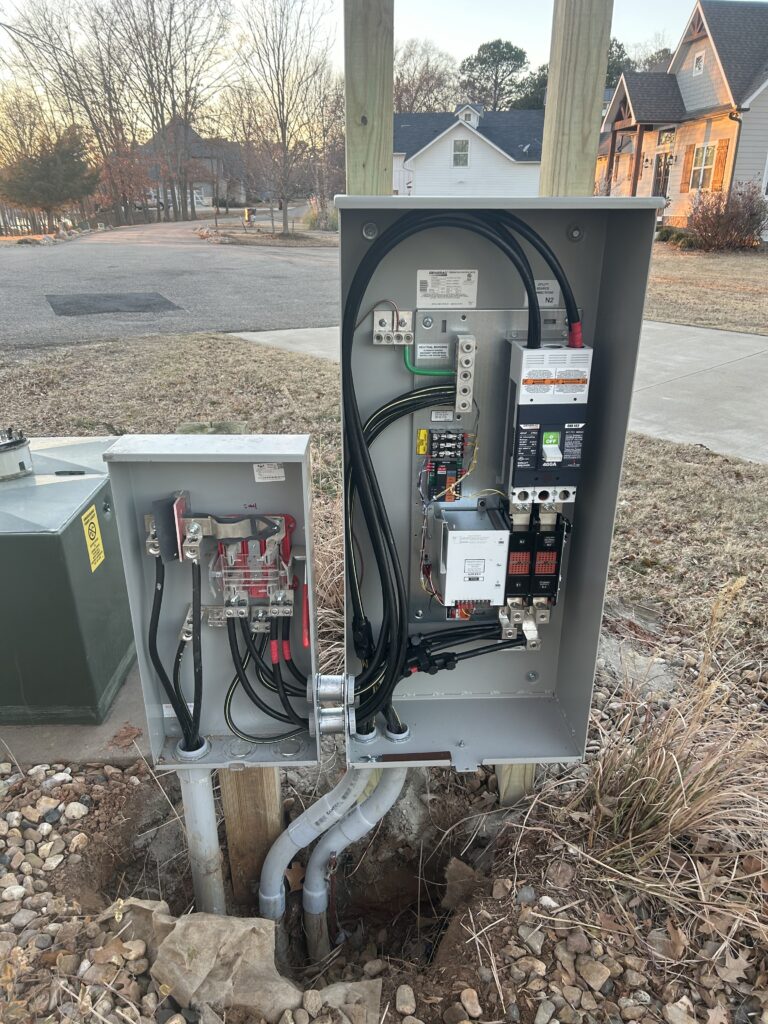
A ground fault circuit interrupter is not measuring how much power you are using; it is comparing the current leaving on the hot conductor against the current returning on the neutral. Any imbalance greater than roughly 5 milliamps tells the device that electricity is finding another path to ground, and it opens the circuit in a fraction of a second. Outdoor receptacles at dwellings are required to have that protection under NEC 210.8(A)(3), and for very good reason. Wet grass, sprinkler spray, ice, and standing water in a flowerbed all create those alternate paths. When your outdoor GFCI keeps tripping in late December but the breaker in the panel stays on, moisture is the prime suspect rather than overload. The fix starts with finding where water is getting into a connection.
Connection points are the weak link in every holiday display. A male plug seated in a female socket outdoors will collect rain, dew, and condensation unless it is protected, and those two prongs sitting in a puddle inside the socket housing are a textbook ground fault. Wrap each connection with electrical tape rated for outdoor use, or better yet use the plastic cord connection covers sold for exactly this purpose. Keep every connection off the ground by hanging it on a stake or clipping it to a railing several inches above grade. Form a drip loop by letting the cord hang below the connection point so that water follows gravity down the cord instead of running horizontally into the plug. Never let a connection sit in a gutter, a downspout splash zone, or the low spot in a yard where water pools after a Texas rainstorm. Small habits like these eliminate the majority of nuisance GFCI trips.
Older outdoor receptacles are frequently part of the problem rather than part of the solution. A flat weatherproof cover that only closes when nothing is plugged in leaves the receptacle wide open all season long, and NEC 406.9(B)(1) now requires a weather resistant receptacle with an in use cover in damp and wet locations. Those bubble style covers close over the cord itself and keep the entire connection dry through a storm. GFCI devices also wear out; the internal electronics degrade after roughly ten to fifteen years of service and begin tripping for no reason at all. Press the test button and then the reset button on your outdoor GFCI before the season starts, and replace any device that fails to trip or refuses to reset. If the receptacle is fed from a GFCI breaker in the panel, the same test applies at the panel. Need reliable outdoor protection before you hang a single strand? Click here for our GFCI outlet installation service.
How Damaged Cords and Loose Connections Blow a Breaker During Holiday Lights Season
Storage is rough on holiday lighting, and the damage rarely announces itself. Cords get crushed under boxes in a hot attic, chewed by mice, kinked around a spool, and cracked by ultraviolet exposure from previous seasons. Insulation that has gone brittle will split the moment you stretch a strand along a fascia board, exposing conductors that were never meant to see daylight. Once two exposed conductors touch, you have a short circuit, and the breaker responds instantly. Inspect every strand and every extension cord on the driveway in daylight before anything goes up. Look for discolored plugs, missing ground pins, melted sockets, and any spot where the outer jacket feels stiff or looks chalky. Damaged strands are inexpensive to replace and expensive to ignore.
Fastening methods cause more holiday electrical failures than almost anything else. Staples driven with a staple gun and nails tapped through a cord jacket will pierce insulation and create a fault that may not show up until the wood swells with moisture weeks later. Use plastic light clips designed for gutters, shingles, and siding, and let the cord rest in the clip without tension. Running a cord through a closed window or under a door crushes the conductors every time the door moves, and that repeated pressure eventually breaks strands inside the jacket. Broken strands raise resistance, resistance creates heat, and heat is how holiday fires start. Never nail through a cord to route it around a corner. If you need power on the far side of the house, the answer is another outlet rather than another hundred feet of cord.
Arc fault circuit interrupter breakers add another layer worth understanding. Many bedroom and living area circuits in newer homes are protected by AFCI or dual function breakers that watch for the specific electrical signature of arcing. A frayed indoor cord or a loose plug in a worn receptacle can produce that signature and trip the breaker even though the circuit is nowhere near its wattage limit. This is the reason an indoor tree with a modest LED load sometimes trips a breaker while a much heavier load on another circuit runs fine. Do not treat a repeat tripping AFCI as a defective breaker; treat it as a warning that something plugged into that circuit is failing. Replace suspect cords, tighten loose receptacle connections, and test again. If the breaker keeps opening with everything unplugged, the problem is in the permanent wiring and needs a licensed electrician.
How to Install Holiday Lights Without Blowing a Breaker
Getting a display right comes down to load planning, correct materials, and enough outlets in the right places. The planning stage takes about twenty minutes with a calculator and saves hours of frustration on a cold evening. Start by identifying which breaker feeds each exterior receptacle, then map what else lives on those circuits. Total the wattage of every light strand, inflatable, and projector you intend to run. Distribute the load across multiple circuits rather than daisy chaining the entire display back to one outlet. Choose cords sized for the length of the run and rated for outdoor use. Finish with a timer that is rated for the amperage you are actually switching.
Calculating Your Holiday Lights Wattage So You Do Not Blow a Breaker
Every listed light set carries a tag or a printed label near the plug that states wattage, amperage, or both. Write those numbers down as you unpack, and group the strands by which side of the house they will cover. Converting between the two units is simple: watts divided by 120 volts gives you amps, and amps multiplied by 120 gives you watts. A display totaling 1,200 watts pulls 10 amps, which fits within the 12 amp continuous ceiling of a 15 amp circuit but leaves almost no room for anything else on that branch. Inflatables deserve special attention because their blower motors run continuously and their startup surge briefly exceeds the running number on the tag. A typical inflatable draws somewhere between 40 and 150 watts depending on size and internal lighting. Add everything together, then compare the total against the 1,440 watt or 1,920 watt working limit for the circuit.
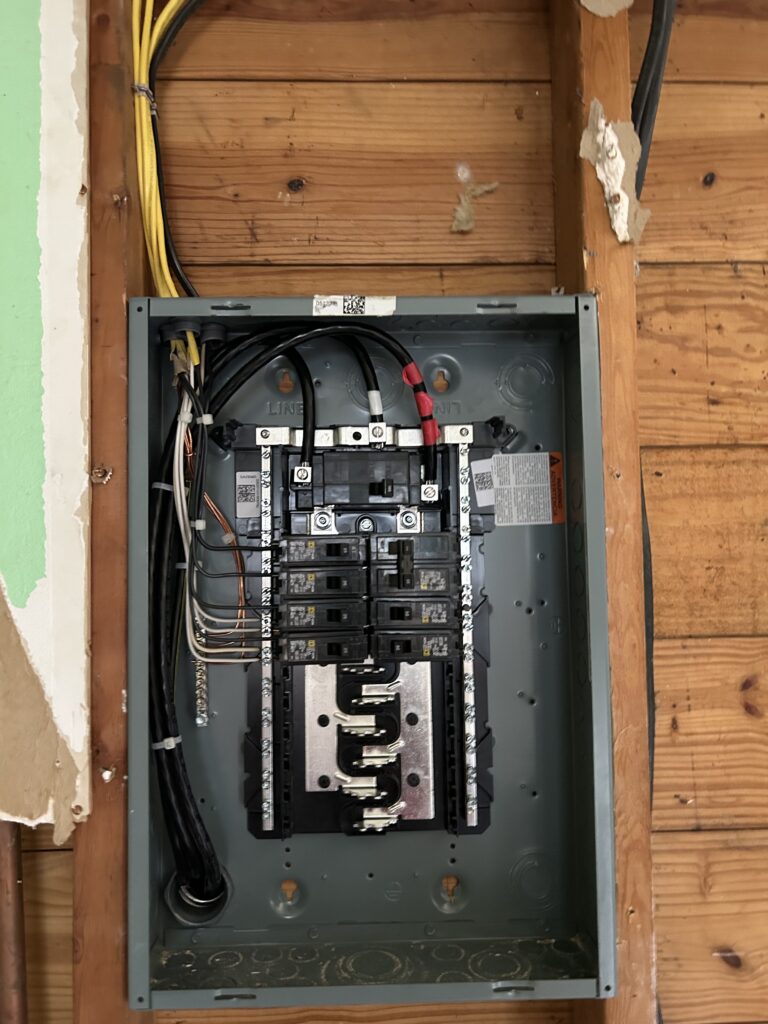
Aim to fill no more than 70 percent of the circuit capacity with holiday lighting, which leaves margin for the loads already present and for the cold weather startup behavior of motors. If your total comes in above that threshold, split the display between two circuits fed from different breakers. A front yard on one circuit and a side yard on another is far more reliable than everything converging on the single receptacle beside the garage door. Verify that you are actually on two different circuits by turning off one breaker and confirming that only half the display goes dark. Two outlets on the same wall are frequently on the same circuit, which defeats the entire purpose of splitting the load. Label your findings on a piece of masking tape inside the panel door so next year takes half as long. Homes with limited panel space or a full breaker box may need additional circuits before a large display becomes practical.
Older houses around Lone Oak, Emory, and Point present an additional consideration worth checking early. Homes with a 100 amp service, an original fuse panel, or aluminum branch wiring have less headroom and less tolerance for added seasonal load. If your panel already runs warm, buzzes, or has breakers that trip during ordinary use, holiday lighting will expose that weakness quickly. A load evaluation tells you exactly how much capacity remains and what the service can support safely. Panels with double tapped breakers, corroded busbars, or discontinued breaker types should be addressed before December rather than during it. Adding a dedicated exterior circuit is often less expensive than homeowners expect and pays off every year afterward. Want a panel that can keep up with your display? Click here for our electrical panel installation service.
Choosing Extension Cords and Timers for Holiday Lights Without Blowing a Breaker
Extension cords intended for outdoor use carry specific markings on the jacket, and those markings are worth reading before the cord leaves the store. Look for a W in the type designation, or the letters SJTW, which indicate a jacket rated for wet locations and outdoor temperatures. Indoor rated cords have thinner insulation that cracks in cold weather and absorbs moisture, and they have no business being part of an exterior display. Gauge matters as much as the rating, because wire that is too thin for the length of the run loses voltage and generates heat. As a practical guide, 16 gauge cord handles light loads up to about 25 feet, 14 gauge is appropriate out to roughly 50 feet, and 12 gauge belongs on runs approaching 100 feet. Heavier gauge is always acceptable; lighter gauge never is. Use one continuous cord of the correct length rather than three short cords chained together, since every connection point adds resistance and another opportunity for water intrusion.
Timers make a display convenient, and the wrong timer becomes a failure point in the middle of the season. Match the timer to the amperage of the load it is switching, and choose a model rated for outdoor use with a sealed or covered housing. Mechanical timers with metal contacts handle inductive loads from inflatable blowers better than some inexpensive electronic models. Photocell controls that turn lights on at dusk work well in Texas, though they need to be positioned away from streetlights and porch fixtures that will confuse the sensor. Keep the timer under a covered porch or inside an in use receptacle cover so rain never reaches the housing. A melted timer body is a clear sign that the load exceeded the rating, and that unit should be replaced rather than reused. Never plug a timer into a timer to extend the schedule.
Ladder work and roof work carry their own set of rules that pair with the electrical side. Keep metal ladders well clear of the service drop, the weatherhead, and any overhead conductors entering the house. Aluminum ladders conduct electricity beautifully, and the clearance you think you have is easy to misjudge while carrying a tangle of lights. Fiberglass ladders are the safer choice for anyone working near electrical equipment. Plan cord routing so nothing crosses a walkway, a driveway, or a stair tread where it becomes a tripping hazard for family and guests. Secure cords along the base of the house rather than across open ground. Working with a helper on the ground makes the entire job faster and considerably safer.
Adding Outdoor Outlets and Circuits for Holiday Lights Without Blowing a Breaker
The permanent solution to seasonal breaker trips is more outlets fed by more circuits. A dedicated 20 amp exterior circuit with weather resistant GFCI receptacles at the front, side, and rear of the house gives you 1,920 watts of continuous capacity that competes with nothing else in the home. Placement matters as much as capacity, since an outlet near the peak of the roofline or under the eave eliminates long cord runs entirely. Many homeowners add a switched exterior receptacle controlled from inside the house, which removes the need to walk outside in the cold to unplug anything. Soffit receptacles are especially popular for permanent holiday lighting and can be installed with the switch located in a garage or entry closet. These upgrades take a licensed electrician a single visit in most cases. Once installed, they serve landscape lighting, pressure washers, and outdoor tools for the rest of the year.
Temporary holiday lighting has its own place in the code, and it is worth knowing the boundaries. NEC Article 590 permits temporary decorative lighting for holidays, with a 90 day limit on that installation before it must come down or be made permanent. Displays that stay up year round are treated as permanent installations and must meet permanent wiring requirements, including proper raceway, listed fixtures, and correct support methods. Homeowners who want a display that lives on the roofline all year should have it installed as a permanent system with dedicated circuits and proper terminations. That approach costs more up front and eliminates ladder work every November. It also removes the cords, clips, and connections that generate most seasonal failures. Discuss the intended lifespan of your display with your electrician before any work begins.
Surge protection deserves a mention since holiday season brings both added electronics and North Texas winter storms. A whole house surge protective device installed at the panel clamps voltage spikes coming in from the utility before they reach the LED drivers, controllers, and transformers scattered around your yard. LED holiday lighting relies on small power supplies that are far more sensitive to voltage transients than old incandescent bulbs ever were. Point of use surge strips protect a single location; a panel mounted device protects everything downstream, including your HVAC equipment and kitchen appliances. Combining both layers gives the strongest coverage for the least ongoing cost. Ready to protect your electronics through storm season? Click here for our whole house surge protection service.
Why You Need a Licensed Electrician Before Holiday Lights Season
Some parts of a holiday display are a homeowner project, and some parts are not. Counting wattage, buying the right cords, and hanging strands with plastic clips are well within reach for most people. Adding circuits, installing exterior receptacles, replacing failed breakers, and evaluating panel capacity require a licensed electrician and, in most jurisdictions, a permit. A repeat tripping breaker that has no obvious overload behind it is a symptom of a wiring problem that needs eyes on it. Getting that work handled in the fall means your display goes up once and stays lit.
What a Professional Holiday Lights and Electrical Inspection Covers
An inspection before the season starts with the service panel, where a technician checks breaker condition, torque on terminations, signs of overheating, and available capacity for additional circuits. From there the exterior receptacles get tested for correct polarity, functioning ground, and GFCI response time. Covers are evaluated for weather resistance, and any flat cover in a wet location gets flagged for replacement with an in use model. The technician also traces which receptacles share circuits so you know exactly where your capacity lives. That map alone prevents most seasonal trips.
Grounding and bonding get attention during the same visit, because a display with a fault relies entirely on the grounding system to clear it safely. Loose ground rod clamps, corroded connections, and missing bonding jumpers all reduce the effectiveness of that protection. Water heaters, gas piping, and metal water lines each have bonding requirements that are easy to overlook in an older home. A technician verifies those connections and corrects anything that has degraded over time. The result is a system that responds correctly the moment something goes wrong.
Wiring in the attic and along exterior walls gets a look as well, since that is where seasonal light installations often intersect with permanent circuits. Rodent damage, deteriorated insulation, and unsupported cable runs show up regularly in homes built before the 1990s. Junction boxes without covers and splices made outside of a box are common findings and simple corrections. Catching these items in October costs a fraction of what an emergency call costs in December. A clean report also gives you confidence to expand your display next year.

When to Call an Electrician About Holiday Lights and Breaker Problems
Call immediately if a breaker refuses to reset with every load unplugged from the circuit, because that indicates a fault in the permanent wiring rather than in your decorations. Burning smells, scorch marks around a receptacle, and warm faceplates all warrant a same day response. A breaker that feels hot to the touch or trips within seconds of resetting should be left off until a technician arrives. Buzzing or crackling from the panel is never normal and should never be ignored. These symptoms tend to worsen under the added load of a holiday display.
Repeated GFCI trips that persist after you have dried and sealed every connection point suggest a failing device or a fault in the buried cable feeding it. Underground conductors to a detached garage, shed, or landscape lighting circuit are common sources of moisture related faults after heavy rain. Testing isolates the section causing the leakage so only the affected portion is repaired. Guessing at underground faults wastes time and often leads to unnecessary digging. Proper diagnostics point directly to the problem.
Flickering lights across multiple circuits, dimming when a motor starts, or lights that brighten in one part of the house while dimming in another point toward a loose neutral at the service. That condition damages electronics quickly and requires prompt attention from a licensed electrician. Do not continue adding load to a system showing those signs. Turn off nonessential circuits and call for service. Need help right now? Click here for our emergency electrician service.
Why Choose Risen Power Electric for Holiday Lights and Breaker Repair
Risen Power Electric is master electrician licensed and insured, and every job is handled with the same attention to long term safety and performance. We serve Lone Oak, Emory, Point, Quitman, Commerce, Caddo Mills, Terrell, Royse City, Forney, Canton, Mineola, Sulphur Springs, West Tawakoni, and Wolfe City. Our team gives honest recommendations without upselling, so you hear what your system actually needs rather than a list of extras. Clear communication runs from the first phone call through the final walkthrough. You will know the scope, the reasoning, and the cost before work begins.
We waive the diagnostic fee when we handle the repair, which keeps troubleshooting affordable for homeowners chasing an intermittent breaker problem. Veteran discounts are available, and emergency electrical service is offered 24 hours a day, seven days a week. Holiday season does not follow business hours, and neither do we. Our technicians arrive with the parts and testing equipment needed to resolve most issues on the first visit. That saves you a second appointment during the busiest weeks of the year.
Fall is the right time to schedule outlet additions, panel evaluations, and GFCI replacements before the December rush begins. A short visit now means your display goes up once and stays lit through the new year without a trip to the breaker panel in the cold. Want a properly wired exterior for your display? Click here for our outdoor lighting installation service. Reach us at (903) 413-7186 or keith@risenpowerelectric.com to schedule an appointment, and we will get your home ready for the season.