
Why Your Kitchen Outlets Trip Every Time You Use the Air Fryer
Air fryers have taken over kitchen counters across Texas, and for good reason, since they cook fast without heating up the whole house during a brutal August afternoon. The problem shows up the moment you press start and the entire counter goes dark. Maybe the outlet itself clicks off, or maybe you walk to the panel and find a breaker sitting in the middle position. Either way, the circuit shut down because something crossed a safety threshold, and that shutdown is protection working correctly rather than a random glitch. Most homeowners assume the air fryer is defective, but the appliance is usually just the final load that pushed an already stressed circuit past its limit. Understanding what actually happens inside your kitchen wiring makes the fix obvious, and it also tells you when the situation has moved from annoying to genuinely unsafe. Risen Power Electric works on kitchen circuits across Lone Oak, Emory, Quitman, and the surrounding communities every week, and the same handful of causes come up over and over.
What Causes Kitchen Outlets to Trip When You Use an Air Fryer
A tripping kitchen outlet almost always comes down to three categories: too much current on one circuit, current leaking where it does not belong, or a connection that has degraded to the point that it cannot carry load anymore. Air fryers pull somewhere between 1200 and 1800 watts, which translates to roughly 10 to 15 amps at standard household voltage. That single appliance can consume most of a kitchen circuit by itself, and it draws that current continuously for the entire cooking cycle rather than in short bursts. When you add a coffee maker, a toaster, or a microwave on the same circuit, the math stops working in your favor. Older kitchens compound the problem because they were wired for a different era of cooking, back when a mixer and a percolator were the heaviest things anyone plugged in. The fix depends entirely on which of those three categories you are dealing with, so identifying the cause matters more than guessing at solutions.
Circuit Overload Causes Kitchen Outlets to Trip When You Use an Air Fryer
Modern electrical code requires kitchen countertop receptacles to be served by at least two dedicated 20 amp circuits, and those circuits are not supposed to feed anything outside the kitchen area. A 20 amp circuit can safely deliver 2400 watts on paper, but for loads that run longer than three hours the working ceiling drops to about 1920 watts. Your air fryer alone can occupy most of that capacity for its entire cooking cycle, which leaves very little headroom for anything else on the same wire. Plug in a 1500 watt toaster oven at the same time and you have asked a 20 amp breaker to pass roughly 27 amps, so it does exactly what it was designed to do and opens the circuit. This is not a defect, and replacing the breaker with a larger one is dangerous because the wire behind the wall is only rated for a specific amount of current. Overloading shows up in a predictable pattern that most homeowners recognize once they think about it, because the trip happens within a minute or two of turning on that second appliance.
Homes built before the mid 1970s frequently have only one general purpose circuit serving the entire kitchen, and in some cases that circuit also feeds the dining room or a hallway. Those older kitchens often run on 15 amp wiring, which caps the safe continuous load somewhere around 1440 watts. An 1800 watt air fryer running alone on that circuit will trip the breaker every single time, no matter how carefully you avoid using anything else. We see this constantly in older farmhouses and remodeled properties around Hunt and Rains County, where the kitchen was updated cosmetically but the wiring behind the cabinets never changed. Granite counters and new cabinet fronts do nothing for circuit capacity. The only real solution in that situation is adding properly sized circuits, which requires running new wire from the panel to the kitchen.
Shared circuits also create trips that seem random because you cannot see what else is drawing power. A refrigerator compressor kicking on adds a brief surge of inrush current that can easily be several times the running amperage of the motor. If the fridge shares a circuit with your air fryer, the combination of a steady heating load and an intermittent motor start can push past the breaker threshold at unpredictable moments. That explains why the outlet sometimes survives a full cooking cycle and other times quits after four minutes. Dishwashers, garbage disposals, and under cabinet lighting on the same circuit produce the same effect. If your kitchen outlets keep tripping under normal cooking loads, click here for our electrical wiring service and we can map out exactly what is sharing that circuit before recommending anything.
Ground Faults Cause Kitchen Outlets to Trip When You Use an Air Fryer
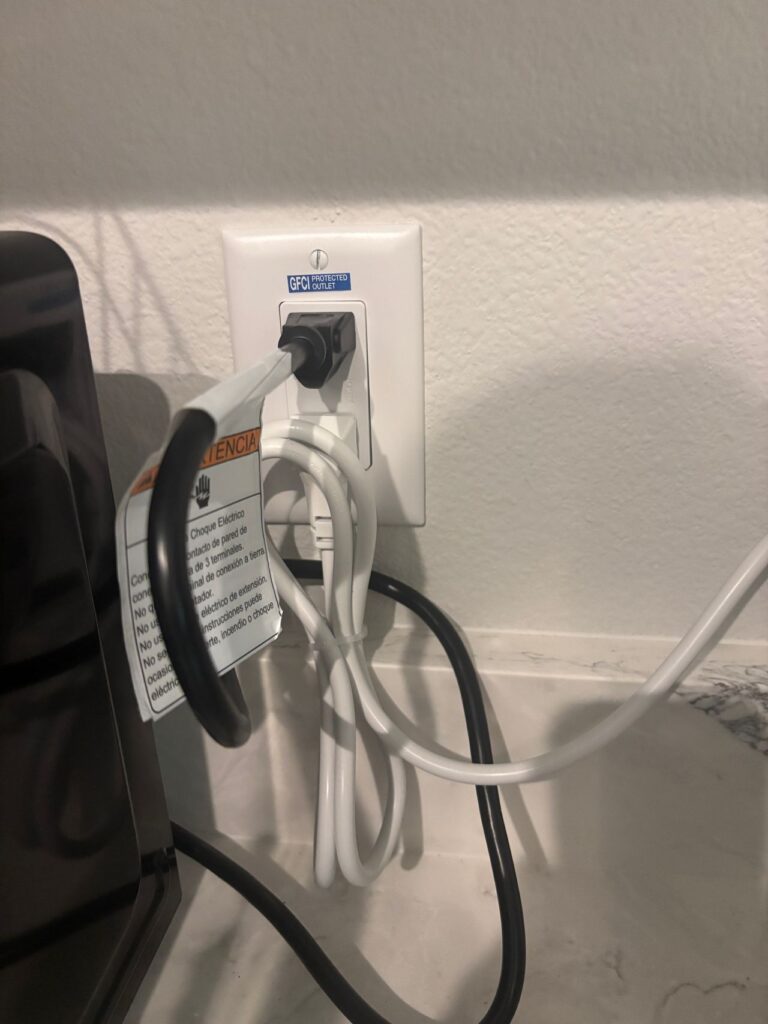
Every kitchen countertop receptacle is required to have GFCI protection, and that device operates on a completely different principle than a circuit breaker. A GFCI compares the current going out on the hot conductor to the current returning on the neutral, and it opens the circuit when those two numbers differ by roughly four to six milliamps. That difference means electricity has found an unintended path to ground, which in a kitchen could easily mean a path through a person standing at a wet sink. The device is deliberately sensitive because the amount of current that causes cardiac harm is far smaller than what it takes to trip a 20 amp breaker. When your outlet clicks off and the reset button pops out, you experienced a ground fault rather than an overload, and those two problems require different repairs. This distinction is the single most useful thing a homeowner can learn about kitchen electrical trouble.
Air fryers create ground fault conditions more often than most appliances because of what happens inside the heating element. The element is a resistance wire packed in insulating material inside a metal sheath, and that insulation absorbs small amounts of moisture over time. When the element heats, that moisture creates a temporary conductive path between the wire and the sheath, which allows a tiny amount of current to leak to the grounded chassis. Sometimes the leakage clears itself after a few cycles as the element dries out, and sometimes it grows worse until the appliance trips the GFCI every time. Steam venting from food is another contributor, particularly in a unit that sits close to a backsplash or under a cabinet where moisture collects. Humidity during a Texas summer makes all of this measurably worse, which is why these calls spike from June through September.
The GFCI device itself also fails, and a failed unit produces trips that have nothing to do with your appliance. These devices contain electronic components that degrade from heat, voltage surges, and simple age, and most manufacturers consider ten years a reasonable service life. A tired GFCI often becomes hypersensitive and starts opening on loads it handled fine for years. There is also a wiring possibility worth checking, since a downstream neutral connected to the wrong terminal or bonded to another circuit will cause the device to sense an imbalance that does not actually exist. That kind of miswiring is common in kitchens where someone added an outlet during a remodel without understanding the line and load terminals. If your kitchen outlet trips and refuses to reset reliably, click here for our GFCI outlet installation service and we will test the device and the circuit behind it.
Worn Wiring and Loose Connections Cause Kitchen Outlets to Trip When You Use an Air Fryer
Receptacles are mechanical devices, and the brass contacts inside them lose tension every time a plug goes in and comes out. After twenty years of coffee makers, blenders, and phone chargers, those contacts no longer grip the plug blades firmly. A loose grip creates resistance, resistance creates heat, and heat accelerates the wear even further in a cycle that gets worse the longer it runs. An air fryer running at 15 amps for thirty minutes generates far more heat at a worn contact than a lamp ever would, which is why the failure surfaces with this appliance first. You can often feel the problem by carefully touching the outlet cover after a cooking cycle, since a warm or discolored faceplate is a clear warning. Any browning, melting, or burnt smell around a kitchen outlet needs professional attention immediately rather than at your convenience.
The connections behind the outlet matter just as much as the contacts in front. Many receptacles were installed using the push in holes on the back of the device, often called backstab connections, which rely on a small spring clip to hold the conductor. Those clips loosen with thermal cycling, and a loose clip under a heavy load produces arcing inside the box. Kitchens built or renovated under recent code cycles also require arc fault protection, and an arc fault breaker will trip in response to exactly that kind of intermittent sparking. Homes with aluminum branch circuit wiring from the 1960s and 1970s face an even higher risk, since aluminum expands and contracts more than copper and oxidizes at the termination point. Proper repair in those homes means terminating the conductors on the screw terminals with the correct connectors rather than simply swapping the outlet.
Wire size is the other half of this equation, and it is not something you can change by installing a different breaker. A 20 amp circuit requires 12 gauge conductors, while 15 amp circuits use 14 gauge. If a previous owner or a handyman installed a 20 amp breaker on 14 gauge wire to stop nuisance trips, the wire can now overheat before the breaker ever notices a problem. That situation is genuinely dangerous because the protective device no longer matches what it is protecting. We find this during electrical inspections more often than homeowners expect, usually in houses that changed hands several times. Voltage drop on a long run also plays a role, since an air fryer at the far end of an undersized circuit draws more current to make up for the lost voltage, and that extra current pushes the breaker closer to its trip point.
How to Tell Which Kitchen Outlet Problem Is Tripping Your Air Fryer Circuit
Diagnosing a tripping kitchen outlet starts with paying attention to what actually shut off, because the device that opened tells you most of what you need to know. Homeowners can safely gather this information without opening anything or touching a single wire. The three things worth noting are which device tripped, how long the appliance ran before it happened, and what else was operating at the same time. Consistency also matters, since a fault that occurs every time points somewhere different than one that shows up twice a month. Write down what you observe over a few cooking sessions and the pattern usually becomes clear. That information saves diagnostic time and helps your electrician go straight to the real problem instead of testing everything in the kitchen.
Checking the Breaker Panel When Kitchen Outlets Trip From an Air Fryer
Start at the panel and look for a handle that has moved out of the full on position, since a tripped breaker usually rests in a middle spot rather than snapping all the way to off. To reset it properly you push the handle firmly to off first and then back to on, because moving it partway does not reengage the internal mechanism. If the breaker refuses to reset, or resets and trips again within seconds with nothing plugged in, you have a short circuit or a ground fault on the wiring rather than an appliance problem. Stop at that point and call an electrician instead of continuing to cycle the handle. Repeated tripping physically wears the internal components of the breaker, and a fatigued breaker eventually loses the ability to trip at its rated current. That failure mode is dangerous because it leaves the wiring unprotected while everything appears to work normally.
Take note of what type of breaker serves your kitchen while you are standing at the panel. A standard thermal magnetic breaker has only a handle, while GFCI and AFCI breakers have a small test button on the face. If your kitchen circuit uses an arc fault breaker and it keeps tripping under load, the cause is often a loose termination somewhere on that circuit rather than an overload. Some older arc fault designs also react poorly to the switching electronics inside modern appliances, and a newer generation breaker sometimes resolves that. Label the breaker once you identify it so you are not testing every switch in the panel next time. A clearly labeled panel is one of the cheapest safety improvements a homeowner can make.
Look at the overall condition of the panel while you are there, because the enclosure itself can be part of the problem. Rust, discoloration around the breaker bus, a burning smell, or a buzzing sound all indicate serious issues that need immediate professional evaluation. Certain panel brands installed decades ago have documented reliability problems with breakers that fail to trip when they should, and those panels should be replaced regardless of any air fryer issue. Panels that are completely full also leave no room to add the dedicated kitchen circuits that would actually solve your problem. If your panel is undersized, full, or showing physical damage, click here for our electrical panel installation service and we will evaluate the whole system rather than just the one circuit that bothers you today. A panel evaluation also tells you how much spare capacity you have for future additions like a car charger or a hot tub.
Testing the GFCI Outlet When Kitchen Outlets Trip From an Air Fryer
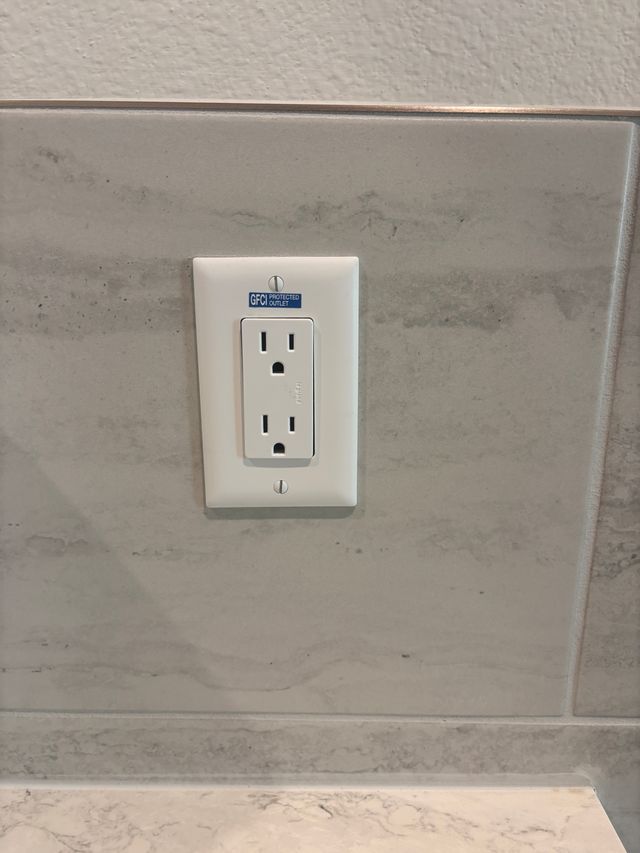
If the breaker in the panel is fine but the outlet is dead, the GFCI has tripped and needs a reset. The reset button is usually on the outlet you are using, but not always, since one GFCI device can protect several downstream receptacles on the same circuit. Check every kitchen outlet, and also look in the garage, the bathroom, and any exterior wall, because a single device sometimes protects outlets in multiple rooms. Press the reset button firmly until it clicks and stays seated. If it will not stay in, the device is either detecting a real fault or has failed internally, and both cases require testing with proper equipment. Do not keep pressing the button repeatedly hoping it will hold.
Run the built in test on a schedule to confirm the device still functions, since a GFCI that does not trip during its own test provides zero protection. Press test, verify the outlet loses power, then press reset and verify power returns. Doing this once a month takes about fifteen seconds and catches a failed device long before you need it to save someone. Newer units include self testing circuitry that monitors the internal components and indicates a fault with a light or an audible signal. A blinking indicator on a self testing device means the unit has reached the end of its useful life and should be replaced. Any GFCI older than ten years is worth replacing on general principle even if it currently passes the test.
Isolate the appliance to determine what is actually causing the fault. Plug the air fryer into a different GFCI protected outlet on a different circuit and run a full cooking cycle. If it trips there as well, the leakage current is coming from inside the appliance and the fix is repair or replacement of the unit. If it runs fine elsewhere, the problem lives in the original circuit and needs professional evaluation. Never solve this by running an extension cord from another room, since most household cords use conductors too small for a 15 amp continuous load and they overheat under the insulation where you cannot see the damage. Air fryers, like all high wattage heating appliances, belong plugged directly into a wall receptacle.
Ruling Out the Air Fryer Itself When Kitchen Outlets Trip
Inspect the cord and plug closely before assuming the house is at fault. Look for cracked insulation, kinks near the strain relief, discoloration on the plug blades, or any blade that sits loose in the outlet. A plug that feels warm after use points to either a worn receptacle or a damaged cord, and both need attention. Check the appliance ground pin as well, since a missing or damaged ground pin defeats an important safety feature. Any cord damage on a heating appliance means the unit should be taken out of service, because internal conductor damage is not visible from the outside. Manufacturers do not recommend repairing these cords, and splicing one is a poor idea in a kitchen environment.
Where the appliance sits also affects how it behaves electrically. Air fryers vent hot moist air from the rear or top, and pushing the unit against a backsplash or running it under a closed cabinet traps that vapor around the housing. Moisture accumulating around electrical components increases leakage current and makes GFCI trips far more likely over time. Give the unit several inches of clearance on all sides and never operate it directly beside the sink where splashing is possible. Wipe down the exterior and the vents regularly, since grease buildup holds moisture and conducts more readily than clean surfaces. These small habits reduce nuisance trips noticeably in humid months.
Age and duty cycle matter too, because heating elements degrade with every cycle and eventually develop enough internal leakage to fail consistently. A three year old air fryer used daily has gone through a great many heating cycles, and rising leakage current is a normal end of life symptom. If the unit trips a GFCI on multiple circuits in multiple rooms, the verdict is clear and no amount of electrical work in your house will fix it. On the other hand, a brand new air fryer that trips only in your kitchen is telling you something about your wiring. The pattern separates the two possibilities cleanly. Test it on a different circuit first, then call an electrician if the appliance behaves everywhere except your kitchen.
Why You Need a Licensed Electrician for Kitchen Outlets That Keep Tripping
A circuit that trips regularly is a warning sign, not a personality quirk to work around. Homeowners who adapt by unplugging the microwave before starting the air fryer are managing a symptom while the underlying condition continues. Loose connections keep heating, worn receptacles keep degrading, and overloaded conductors keep operating closer to their limits than they should. Electrical fires in kitchens frequently begin at connection points that showed warning signs for months before anything ignited. A licensed electrician can measure actual current draw, verify conductor sizing, check terminations, and tell you exactly what your kitchen needs. That evaluation usually costs far less than homeowners expect and eliminates the guesswork completely.
Safety Risks of Ignoring Kitchen Outlets That Keep Tripping
Heat is the mechanism behind nearly every electrical fire, and heat comes from resistance at points where current has to squeeze through a compromised connection. A loose terminal screw or a fatigued backstab clip creates a hot spot inside the wall cavity where nobody can see it. Insulation on the conductor breaks down slowly under that heat, and wood framing and paper faced insulation surround the box. Kitchens add grease and dust to the mix, both of which ignite readily once a source gets hot enough. Nothing about this process is fast, which is precisely why it goes unnoticed until it matters.
Defeating a safety device makes the risk considerably worse. Installing a larger breaker to stop nuisance trips removes the protection the wire depends on, and bypassing a GFCI removes the protection people depend on. Both of these shortcuts appear regularly in homes where someone tried to solve the problem without understanding it. Overcurrent devices exist to protect the conductor, and ground fault devices exist to protect the person standing on a tile floor near a sink. Neither one is optional in a kitchen, and neither should ever be enlarged or removed to accommodate an appliance.
There is also a straightforward cost argument. Repeated tripping wears out breakers, damages receptacles, and shortens the life of the appliances plugged into a struggling circuit. Adding a properly sized circuit costs a fraction of what fire damage or an insurance dispute costs. Insurance carriers can and do investigate the origin of electrical fires, and evidence of improper modifications complicates a claim. Doing the work correctly the first time is simply the cheaper path.

Upgrades That Stop Kitchen Outlets From Tripping for Good
The permanent fix for an overloaded kitchen is almost always additional circuits. Running new 20 amp circuits from the panel to the countertop area gives your appliances room to operate at the same time without competing for capacity. In many kitchens this means adding two circuits and redistributing the existing receptacles across them so no single wire carries everything. Heavy appliances like a built in microwave or a dishwasher should be on their own dedicated circuits rather than sharing counter space wiring. The work involves running new cable, installing new receptacles, and adding breakers at the panel.
Older homes often need service capacity addressed before anything else can happen. A 100 amp service that was adequate in 1972 has to support central air conditioning, electric water heating, and a kitchen full of appliances that did not exist back then. If your panel has no open spaces and your service is undersized, adding kitchen circuits requires expanding capacity first. A service upgrade also brings your grounding and bonding up to current standards, which improves how every protective device in the house performs. If your home cannot support the circuits your kitchen actually needs, click here for our electrical service upgrade service and we will size the work to what your household really uses.
Receptacle and device upgrades round out the job. Replacing worn outlets with quality specification grade devices restores firm contact tension and eliminates the heating that comes from loose blades. Current GFCI devices with self testing circuitry monitor themselves continuously and alert you when protection is lost. Proper terminations on screw terminals with correct torque values give you connections that stay tight through years of thermal cycling. These upgrades are inexpensive relative to what they prevent, and they make a noticeable difference in how the kitchen performs day to day.
Why Choose Risen Power Electric for Kitchen Outlets That Keep Tripping
Risen Power Electric is master electrician licensed and insured, and every kitchen circuit we touch gets evaluated against current code rather than what was acceptable when the house was built. We measure actual load, check conductor sizing, and inspect terminations before recommending anything, because guessing wastes your money. Our diagnostic fee is waived when we handle the repair, so the evaluation is not a separate expense stacked on top of the work. You get clear communication from the first phone call through the final walkthrough, with plain explanations of what we found and why it matters. We give honest recommendations without upselling, which sometimes means telling you the air fryer is the problem and your wiring is fine.
We serve Lone Oak, Emory, Quitman, Point, West Tawakoni, Commerce, Canton, Terrell, Sulphur Springs, Royse City, Caddo Mills, Wolfe City, Forney, and Mineola. Veteran discounts are available, and we offer emergency electrical service around the clock for situations that cannot wait until morning. Burning smells, warm outlets, scorched faceplates, and breakers that will not reset all fall into that category. Our focus stays on long term safety and performance rather than the fastest possible patch. That approach is why so much of our work comes from repeat customers and neighbor referrals.
If your kitchen outlets trip every time you use the air fryer, the circuit is telling you something worth listening to. We will identify the cause, explain your options clearly, and complete the work to code so the problem stops for good instead of returning next summer. Scheduling is straightforward and we work around your household routine as much as possible. Call Risen Power Electric at (903) 413-7186 or email keith@risenpowerelectric.com to set up an evaluation, and stop rearranging your cooking around a breaker.