
How to Prepare Your Electrical Panel for Heavy Fall and Winter Loads
Fall arrives in Northeast Texas with mild days and cold snaps that show up without much warning, and your electrical panel feels that shift before you do. Heating equipment, holiday lighting, space heaters, and well pumps all start competing for the same limited amount of amperage, and the panel is the single point where every one of those demands meets. A service that handled summer cooling without complaint can still struggle in December, because electric heat behaves very differently from an air conditioner and stays on far longer during a hard freeze. Loose lugs, corroded bus bars, tired breakers, and undersized service capacity rarely announce themselves in October; they announce themselves at two in the morning when the temperature drops into the twenties and everything in the house is running at once. Preparing the panel now costs very little and takes an hour or two of a qualified electrician’s time. Ignoring it can mean a dead furnace on the coldest night of the year, a burned bus stab, or a panel replacement performed under emergency conditions at emergency prices. This guide walks through what actually changes inside your panel during the cold months, the specific warning signs worth acting on, and the practical steps that get a residential service ready for winter. Everything here reflects how licensed electricians evaluate real panels in real homes, not general advice that sounds good but does nothing for your wiring.
Why Your Electrical Panel Struggles With Heavy Fall and Winter Loads
Most homeowners assume summer is the hardest season on an electrical system, since that is when air conditioners run constantly and the grid gets stressed. Inside the panel, winter is often worse. Electric resistance heat, heat pump auxiliary strips, well pumps working against colder ground, and portable heaters plugged in across the house create sustained draw rather than short bursts. Sustained draw is what heats conductors, softens terminations, and exposes any connection that was never torqued correctly in the first place. Panels also sit in garages, utility rooms, and on exterior walls where temperature swings and condensation accelerate corrosion. When you combine a decades old service with modern winter load, the math stops working long before the equipment stops running. Understanding why that happens makes the preparation steps much easier to prioritize.
How Cold Weather Increases Electrical Panel Demand
The core issue is that heating a house electrically takes enormous current compared to almost anything else a residential service supplies. A single bank of electric resistance heat strips in an air handler commonly draws between forty and sixty amps at 240 volts, and larger systems use two banks that stage on together during deep cold. A heat pump that handles a fifty degree morning without help will call for those strips when the outdoor temperature falls into the thirties, because the refrigerant cycle simply cannot pull enough heat from cold outside air. That means the same equipment that used four or five amps in October can pull ten times that amount in January, and it can do so for hours at a stretch rather than in short cycles. Add a well pump, a water heater recovering after morning showers, and a clothes dryer running a heavy load, and a 100 amp service can find itself near its limit on an ordinary winter weekday. Your panel does not fail the moment it gets busy, but it does start running warm, and warm connections degrade faster than cool ones.
Portable space heaters deserve their own attention because they quietly reshape the load profile of an entire house. A standard 1500 watt heater draws roughly 12.5 amps on a 120 volt circuit, which consumes nearly the entire safe capacity of a 15 amp branch circuit by itself. The National Electrical Code treats any load running three hours or longer as continuous and limits it to eighty percent of the breaker rating, so a 15 amp circuit is really only good for 12 amps of continuous draw. One heater alone puts that circuit over the line, and homeowners routinely plug a heater into a bedroom outlet that already shares a circuit with lamps, a television, and phone chargers. The result is a breaker that trips repeatedly, or worse, a circuit that carries too much current through an outlet that was never designed for it. Multiply that by three or four heaters across a house during a cold week and the panel carries load it never saw during design. This is one of the most common causes of winter electrical calls in homes around Lone Oak, Emory, and Point.
Holiday lighting and seasonal equipment stack onto that same base load at exactly the wrong time. Exterior receptacles are frequently fed by a single 20 amp GFCI circuit that also serves a garage, a porch, and sometimes a workshop outlet. Older incandescent light strings pull far more current than LED replacements, and inflatable yard decorations run continuous motors that add up quickly across a display. Kitchens see heavier use through November and December, with countertop appliances, ovens, and warming devices running simultaneously during gatherings. None of these loads is dangerous on its own, and none would matter in a house with adequate capacity and healthy terminations. The problem is cumulative, and the panel is where the cumulative total either gets handled cleanly or starts creating heat. If your breakers already trip during ordinary use, adding winter load will make that far worse rather than better.

Warning Signs Your Electrical Panel Cannot Handle Winter Loads
Repeated breaker tripping is the clearest signal, and it is also the one most often misread. A breaker that trips is doing its job, and replacing it with a larger one does not solve anything; it removes the protection that keeps the wire from overheating. Pay attention to which breaker trips and under what conditions, because a pattern tells an electrician a great deal. A breaker that trips only when the heat strips engage points toward a capacity or connection issue on that circuit. A breaker that trips when a space heater runs in a specific bedroom points toward an overloaded branch circuit. A main breaker that trips is a much more serious matter, since it usually indicates the total service demand exceeds what the panel can supply. Any breaker that trips and then feels warm to the touch on the handle deserves professional evaluation before winter arrives.
Physical symptoms at the panel itself carry even more weight. A faint burning smell near the panel, a buzzing or crackling sound from inside the enclosure, or visible scorching around a breaker are all reasons to stop and call a licensed electrician immediately. Rust streaks on the bottom of the cabinet indicate water intrusion, which corrodes bus bars and creates high resistance connections that generate heat under load. Breakers that feel loose in their stabs, or that require force to reset, have often lost proper contact with the bus. Discoloration on a neutral bar or a bare copper conductor that shows a bronze or bluish tint is evidence of past overheating. These conditions do not improve on their own, and winter load is precisely what turns a marginal condition into a failure. Our team handles this work regularly, and you can find details on our electrical panel repair service if you have noticed any of these symptoms.
Symptoms elsewhere in the house also point back to the panel more often than homeowners expect. Lights that dim noticeably when the heat pump starts, or that flicker on a regular rhythm, suggest a voltage drop that can originate at the service conductors, the main lugs, or the utility connection. Outlets that no longer hold a plug snugly, or that feel warm when a heater is used, indicate a branch circuit problem that becomes dangerous under sustained winter draw. Partial power loss, where half the house goes dark while the other half stays energized, often signals a failing service neutral or a loose connection on one leg of the incoming feed. That particular condition can send high voltage to sensitive electronics and destroy them in seconds. If your lights brighten in one room while dimming in another, shut off the main and call for service rather than waiting to see what happens. Fall is the right time to chase down these symptoms, because the same problem in January often arrives with a freeze and a full schedule.
Older Electrical Panel Types That Fail Under Winter Loads
Certain panel brands have documented failure histories, and heavy winter load is exactly the condition that exposes them. Federal Pacific Electric Stab Lok panels, common in homes built from the 1950s through the early 1980s, have been widely reported to fail to trip under overload conditions. A breaker that does not trip when it should leaves the branch wiring unprotected, which means an overloaded circuit can heat the conductor rather than opening safely. Zinsco and Sylvania Zinsco panels present a related problem, where breakers can fuse to the bus bar and continue passing current even after the handle moves to the off position. Both designs were manufactured before modern residential loads existed, and neither was built for a house running electric heat, an EV charger, and a modern kitchen. If you own a home in this area with an original panel from that era, replacement is the appropriate response rather than repair.
Split bus panels are another category worth identifying before cold weather. These panels lack a single main breaker and instead use several main disconnects, often six, with the lower section fed through one of them. They were entirely legal when installed, but they are typically rated at 100 amps or less and were designed around gas heat and far fewer circuits. Adding a heat pump, a hot tub, or a shop subpanel to a split bus service usually pushes it beyond what the equipment can support. Finding replacement breakers for these panels has also become difficult and expensive, since most are no longer produced. When a breaker in a split bus panel fails during a cold snap, the wait for parts can be longer than the wait for a full replacement.
Even a modern panel can become a winter liability through overcrowding and improper modifications. Double tapping, where two conductors land under a single breaker terminal designed for one, creates a loose connection that heats under load and is a frequent finding during inspections. Tandem breakers installed in slots not rated for them can overload the bus, and a panel filled to capacity leaves no room for the circuits a homeowner needs to add. Missing knockout covers, unlabeled circuits, and mixed manufacturer breakers all indicate work performed without proper attention to listing requirements. Aluminum branch wiring from the mid 1960s and 1970s requires specific connectors and terminations to prevent oxidation at every splice and device. A thorough evaluation catches these issues while the weather is mild, and if the findings point toward replacement, our electrical panel installation service covers the full process from permit to final inspection.
How to Prepare Your Electrical Panel for Heavy Fall and Winter Loads Step by Step
Preparing a panel for winter is a defined process, not a vague inspection. It starts with knowing how much capacity you actually have and how much your home will demand at peak, then moves through the mechanical condition of the panel, and ends with capacity decisions if the numbers do not work. Some of this is homeowner territory, like documenting which circuits feed what and reducing unnecessary load. Most of it belongs to a licensed electrician, because opening a panel exposes the service conductors, which remain energized even with the main breaker off. Done properly, the work takes one visit and gives you a clear picture of what your system can handle through February. Done reactively, it turns into an emergency call during a freeze. The steps below reflect what a qualified electrician actually performs on a residential service.
Start With an Electrical Panel Load Calculation Before Winter
A load calculation determines the real demand on your service using the method defined in Article 220 of the National Electrical Code, not a guess based on how things feel. The calculation accounts for general lighting and receptacle load based on square footage, small appliance circuits, laundry, fixed appliances, and the largest of either heating or cooling load. That last point matters enormously in Texas, because the code allows an electrician to count only the larger of the two, and for many homes with electric strip heat the winter number is the larger one. A 2,400 square foot home with a heat pump, ten kilowatts of auxiliary heat, an electric water heater, a range, and a dryer can calculate out well past what a 100 amp service can safely carry. Running that calculation in September tells you exactly where you stand before the first cold front. It also produces documentation you will need if a service upgrade or a permit becomes necessary.
The calculation should include anything you plan to add during the coming year, because capacity decisions are far cheaper when made once. EV chargers are the most common addition and the most significant, since a Level 2 charger at 48 amps continuous requires a 60 amp circuit and consumes a substantial share of a 200 amp service. Hot tubs typically require a 50 amp GFCI protected circuit and run heaters that cycle throughout the night in cold weather. Shop equipment, well pump upgrades, and additional heating for a converted garage all belong in the same conversation. An electrician who knows your plans can size the service and the panel to accommodate them rather than leaving you short in two years. Load management devices are also an option in some situations, allowing an EV charger to reduce output automatically when household demand climbs.
Homeowners can contribute meaningfully to this step by documenting their own usage before the electrician arrives. Walk the house and note every 240 volt appliance, then check the nameplate on the air handler for the heat strip kilowatt rating. Identify which rooms rely on space heaters during winter and how many are typically running at once. Look at the main breaker rating stamped on the handle, since that number defines your service size and is often 100, 125, 150, or 200 amps. Note the panel manufacturer and the number of open slots remaining. This information saves diagnostic time and makes the resulting recommendations far more specific to how you actually live in the home.
Inspect and Service Electrical Panel Breakers and Connections
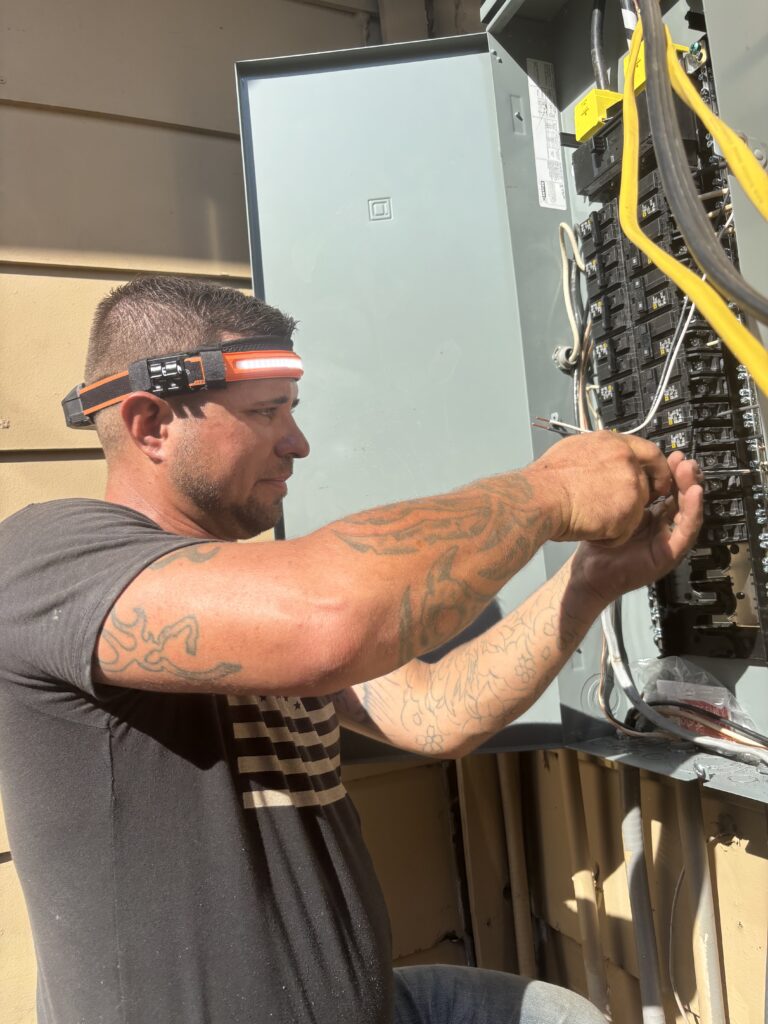
Thermal issues account for a large share of panel failures, and nearly all of them trace back to connections that are not tight. Every termination in a panel has a specified torque value, printed on a label inside the enclosure, and connections installed by hand feel without a torque screwdriver frequently fall outside that range. A loose lug creates resistance, resistance creates heat, and heat causes the metal to expand and contract until the connection loosens further. Over years, that cycle produces the scorched terminals electricians find during service calls. Retorquing main lugs, neutral and ground bar screws, and breaker terminals to manufacturer specification is a straightforward task that meaningfully reduces failure risk. It requires the panel to be de energized properly and should never be attempted by a homeowner.
Breaker condition also deserves direct evaluation rather than assumption. Circuit breakers are mechanical devices with springs and contacts, and they wear out, particularly ones that have tripped many times over the years. A breaker that has been overloaded repeatedly can develop a lower trip threshold, causing nuisance tripping, or a higher one, which is far more dangerous. Testing includes verifying that each breaker seats firmly on the bus, checking for heat discoloration at the stab, and confirming that GFCI and AFCI devices trip and reset correctly. AFCI protection matters more in winter because arcing faults often develop in circuits stressed by heater use. If you are already dealing with breakers that trip without an obvious cause, our circuit breaker repair service addresses the underlying issue rather than simply swapping parts.
The panel enclosure and its surroundings round out the inspection. Water intrusion from a failing weatherhead or a compromised meter base allows moisture into the cabinet, where it corrodes the bus and creates high resistance points. Debris, insulation, and stored items packed around a panel restrict the working clearance the code requires and trap heat. Grounding and bonding get verified at this stage, including the connection to the grounding electrode system and proper separation of neutrals and grounds in subpanels. Circuit labeling gets corrected so that anyone can identify and shut off a specific circuit during an emergency, which matters most when something goes wrong at night in bad weather. Surge protection is worth adding at the same visit, since winter storms and utility switching events send transients through the service. A properly installed whole home surge device protects the heat pump control board, which is one of the more expensive components to replace in the middle of a cold week.
Upgrade Electrical Panel Capacity Before Winter Loads Peak
When a load calculation shows demand approaching or exceeding service capacity, an upgrade becomes the correct answer rather than an optional improvement. Most homes built before the 1990s in this region received 100 amp or 125 amp services, sized for gas heat and a fraction of today’s appliance load. Moving to a 200 amp service replaces the meter base, service entrance conductors, panel, and grounding electrode system, and it typically requires coordination with the utility and a permit from the local jurisdiction. The work usually takes a single day with a planned power interruption, and scheduling it in fall means the outage happens on a mild afternoon rather than during a freeze. Capacity gained during an upgrade also opens the door to EV charging, a generator interlock, and additional circuits without further modification. Our electrical service upgrade page explains what the process involves from start to finish.
Subpanels solve a different problem and are worth considering when the service itself is adequate but the panel has run out of physical space. A subpanel fed from the main service provides additional breaker positions for a garage, workshop, addition, or outbuilding without replacing the entire service. Proper installation requires a four wire feeder with separated neutrals and grounds at the subpanel, correctly sized conductors, and a grounding electrode where the subpanel serves a detached structure. Done correctly, a subpanel makes the system more organized and easier to service. Done incorrectly, it introduces objectionable current on grounding conductors and creates a shock hazard that is not obvious from the outside. This is one of the areas where licensed work matters most.
Backup power belongs in the same planning conversation, since winter is when outages carry the highest consequences. A standby generator with an automatic transfer switch keeps heat, water, and refrigeration running when ice takes down lines, and it protects plumbing from freezing during extended outages. Portable generators can serve the same purpose at lower cost, but they require a properly installed inlet and interlock so power cannot backfeed onto utility lines and endanger line workers. Sizing the generator depends directly on the load calculation, which is another reason to complete that step first. Integrating a generator into an aging panel is rarely practical, so the two projects often make sense together. Planning this in early fall gives you time for equipment lead times and permitting before the first hard freeze arrives.
Why You Need Professional Electrical Panel Preparation Before Winter
Panel work sits behind a licensing requirement for a reason. The service conductors entering your panel stay energized after the main breaker opens, and they carry enough current to be fatal on contact. Beyond the safety issue, correct panel work requires knowledge of code requirements, torque specifications, breaker listing compatibility, and load calculation methods that take years to develop. A professional evaluation in October costs a fraction of an emergency replacement in January, and it gives you a written picture of what your system can handle. Risen Power Electric performs this work throughout Lone Oak, Emory, Point, Quitman, Commerce, Terrell, and the surrounding communities. Getting on the schedule now means the work happens on your timeline instead of during a cold snap.
What Professional Electrical Panel Preparation Includes
A complete panel evaluation starts with a full load calculation based on your home’s square footage, appliances, and heating equipment. From there, the panel gets opened and inspected under safe conditions, with every termination checked for heat damage, corrosion, and correct torque. Breakers are tested and evaluated individually, and GFCI and AFCI devices get verified for proper operation. The grounding and bonding system is confirmed, circuits are labeled accurately, and any code violations are documented clearly. You receive a straightforward explanation of what is in good condition, what needs attention now, and what can reasonably wait.
The evaluation also covers the parts of the system that feed the panel and depend on it. Service entrance conductors, the weatherhead, and the meter base get checked for wear and water intrusion, since problems there show up as panel problems. Branch circuits serving high draw winter equipment are examined at both ends, because a loose connection at a receptacle causes just as much trouble as one at the breaker. Surge protection, generator readiness, and available capacity for future additions are all addressed in the same visit. Our electrical inspection service covers this scope in detail for homeowners who want a complete picture before winter.
Documentation is a meaningful part of the value, particularly for homes that may sell within a few years. A written record of panel condition, load calculation results, and any corrections performed answers questions that come up during real estate transactions and insurance reviews. Homes with Federal Pacific or Zinsco panels often face insurance complications, and having documentation of a replacement resolves that issue permanently. Clear circuit labeling also helps every future service call go faster, which saves money over time. These are small benefits individually and substantial ones together.
When to Schedule Electrical Panel Preparation for Winter
Early fall is the ideal window, and the reason is entirely practical. Service upgrades require utility coordination and permits, and both processes take longer during peak demand periods. Equipment for a panel replacement or generator installation can carry lead times measured in weeks, and those lead times stretch after a regional cold event. Scheduling in September or October means the work is finished before the first serious front pushes through. Waiting until symptoms appear in December usually means paying emergency rates for a job that could have been routine.
The second consideration is comfort during the work itself. A panel replacement or service upgrade requires the power to be off for several hours, and that is a manageable inconvenience on a seventy degree day. The same outage during a hard freeze creates real problems for occupants, pets, and plumbing. Homes with medical equipment, home offices, or young children have even less flexibility in cold weather. Scheduling ahead lets you choose the day rather than accepting whatever is available.
Certain findings justify moving immediately regardless of the calendar. Burning smells, buzzing from the panel, visible scorching, repeated main breaker trips, and partial power loss are all conditions that should be addressed the same day. Homes with known problem panel brands should schedule evaluation without waiting for symptoms, because those designs can fail without warning. If you are unsure how urgent your situation is, describing the symptoms over the phone usually clarifies it quickly. We would rather answer that question in October than respond to it in January.
Why Choose Risen Power Electric for Electrical Panel Preparation
Risen Power Electric is a Master Electrician licensed and insured company serving Lone Oak and the surrounding Northeast Texas communities, and panel work is a core part of what we do. Every evaluation is performed with the same standard of care applied to a full service upgrade, because the conditions that cause winter failures are often small ones found early. We give honest recommendations without upselling, which means we will tell you plainly when a panel is in good shape and needs nothing beyond retorquing and labeling. When replacement genuinely is the right answer, we explain exactly why and what the work involves. Clear communication from start to finish is something we take seriously, and it applies to pricing as much as to scope.
We offer 24/7 emergency electrical services, which matters most during the months when a panel failure leaves a home without heat. Diagnostic fees are waived if we handle the repair, so having us identify the problem does not add cost to the solution. Veteran discounts are available, and we appreciate the chance to serve those who served. Our focus is long term safety and performance rather than the fastest possible fix, because a panel installed correctly should last decades without trouble. That approach has built our reputation across Lone Oak, Emory, Point, Quitman, Commerce, Caddo Mills, and Terrell.
Getting your panel ready for fall and winter takes one appointment and removes one of the most common causes of cold weather emergencies. Call Risen Power Electric at (903) 413-7186 to schedule an evaluation, and we will give you a clear picture of what your electrical system can handle before the first freeze arrives. Planning for backup power as well? Take a look at our generator installation service to see what fits your home and your load. We are located at 7469 Shoreline Drive in Lone Oak, and you can also reach us at keith@risenpowerelectric.com. Schedule now while the weather is still on your side.